Reinickendorf
The Reinickendorf Northern Alliance (Reinickendorfer Nordbund) is composed of people who, even before the great flood, preferred to live in places others would never choose to visit. Their settlements are scattered among patches of forest, industrial yards, and locations marked on official maps with notes like "presumably still there."
The Northern Alliance has little interest in grand visions. If someone proposes a new social order, the people of Reinickendorf first ask whether that person knows how to get a frozen pump running again.
In military terms, the Northern Alliance rarely appears where it is expected—if it shows up at all. Yet, somehow, a bridge might suddenly go missing.
[!quote] "Politics? I thought we were going to fix the roof first."
Schöneberg
The Schöneberg Archipelago is that part of New Berlin where, even while standing on a floating compost island, one might still feel as though one had been invited to a formal reception. Amidst green rooftops and neatly tended planting islands, there prevails a firm conviction that a catastrophe only truly qualifies as an "end of the world" if the salad has been poorly arranged.
Schöneberg thrives on the compost of moral superiority: seeds, herbs, and the act of explaining to other people what "proper" gardening entails. Mia rules with a kind of impolite persistence—which, in practice, amounts to much the same thing as polite persistence, only the tablecloth ends up looking a bit more amusing.
[!quote] Quote [[Mia Von Schöneberg]] "We would like to kindly point out that, without us, your tomatoes look like absolute shit."
Kreuzberg
The Kreuzberg Hijack Collective (Kreuzberger Kaperbund) is flamboyant, eccentric, and fundamentally opposed to the status quo. Its members include artists, political theorists, and—to put it broadly—people who, seven years ago, happened to end up on the wrong boat and have somehow remained part of the crew ever since.
In Kreuzberg, actual ships are rarely hijacked. Far more often, it is vacant buildings or warehouses that are taken over and subsequently declared to be for "temporary autonomous use."
Lichtenberg
The Lichtenberg Steel Squadron considers decoration a form of corrosion. If asked, "Can this be fixed?", members of the Lichtenberg faction invariably take offense.
The Steel Squadron works with pumps and welding equipment—which leads to frequent collaborations with [[Tempelhof Diskoord]].
Politically, the Steel Squadron is interested primarily in what actually works. In Kreuzberg, this approach is dismissed as unimaginative; in Lichtenberg itself, it is simply called "Wednesday."
[!quote] "If you want it to look pretty, ask Mitte. If you want it to last, get out of the way."
Pankow
The Pankow Free Corps is arguably the most democratic organization in New Berlin—and, consequently, its capacity for action is somewhat limited. No decision is ever reached without first being reformulated a dozen times, only to then be opposed by someone who had originally supported it.
Once Pankow finally reaches a consensus, however, the clan moves with the determination of people who have spent six weeks doing nothing but discussing that very subject.
Pankow produces leaflets, manifestos, educational programs, and a staggering number of minutes—including minutes debating whether even more minutes are necessary.
[!warning] In urgent emergencies, the average response time is three meetings.
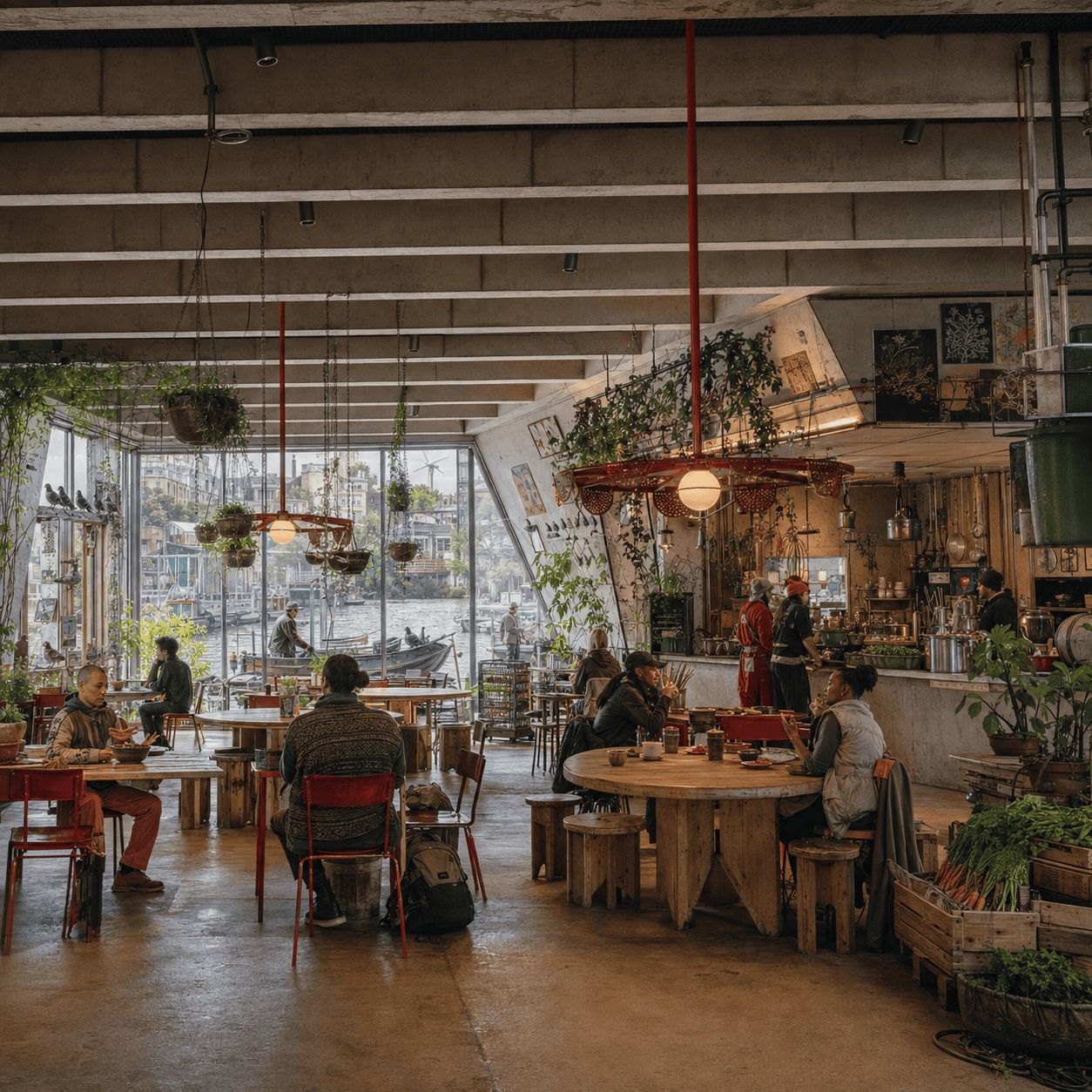
Spandau
The Spandau Bulwark is a clan that, when faced with the question "Does it really have to be this difficult?", always answers with a resounding "Yes." Even when out fishing, their ships look as though they are about to annex a port.
Spandau controls several key access routes and considers border security a form of courtesy. Foreign vessels are subjected to inspections so thorough that everyone on board ends up forgetting why they came in the first place.
On the flip side, the Bulwark is reliable. Those under Spandau’s protection are defended—even if they don’t want to be.
[!quote] "We can talk about anything. On the other side of the barrier."
Neukölln
The Neukölln Free Port insists that it is not a clan. It merely possesses a shared territory, common interests, mutual enemies, collective defense measures, and a common flag. But a clan? Absolutely not.
Neukölln is a hodgepodge of clubs, bars, and boats—the owners of which aren't even entirely sure themselves whether they’re currently conducting business or just moving house.
Whatever [[EVERYTHING|EVERYTHING]] doesn’t have, you’ll likely find at the Free Port. And whatever [[EVERYTHING|EVERYTHING]] doesn’t have—for very good reasons—you’ll find there, too.
Political order emerges either through mutual tolerance or the tactic of retraining any central authority figure as a DJ within two days.
[!quote] “What’re you looking for?” “No idea.” “Perfect. Second pier on the left.”
Mitte
Following the collapse of the old administration, the Central Consortium Mitte decided that history becomes especially valuable precisely when no one knows who owns what anymore. It is a cherished custom among the Consortium’s members to inform newcomers that, unfortunately, one is not permitted to drown without first filing form B-17.
The Consortium possesses surprisingly little official power, yet wields an extraordinary amount of influence over what qualifies as "official." They operate on the firm conviction that a rubber stamp creates a social reality—and, annoyingly enough, this often works.
Its members view themselves as guardians of the past. Everyone else views them as people who still issue deeds of ownership for buildings whose ground floors lie twenty meters underwater.
[!quote] "Of course you may set foot on the island. Just as soon as the history of its usage has been clarified."
Prenzlau
The Prenzlauer Höhenbund (Prenzlauer Heights Alliance) lives on rooftops—a fact they consider a cultural advantage. While other clans control waterways, Prenzlauer Berg boasts cable cars and a multitude of rooftop gardens, providing the perfect vantage point from which to pass moral judgment on the rest of New Berlin.
The Höhenbund produces fermented goods with names that are generally longer than the products' own shelf lives.
In terms of naval warfare, the Höhenbund is rather mediocre. On the other hand, the clan spots any threat ten minutes earlier than anyone else—giving them an extra ten minutes to talk about it.
[!tip] If you ask someone from Prenzlauer Berg for directions, the first thing you’ll get is a recommendation for a better route.
Köpenick
The Köpenick River Squadron is made up of people who don’t just own a boat—they seem to be genetically part of one. Its captains know the currents and shallows so intimately that they view nautical charts as an insulting oversimplification.
Engines are used only when wind and current fail—and even then, so discreetly that no one else in the family ever finds out.
Köpenick shares a long-standing rivalry with Spandau. Spandau argues that a vessel must be sturdy; Köpenick maintains that if you truly know how to steer, you won’t ever bump into anything.
[!quote] “You call that ‘armor.’ We call it ‘being afraid to steer.’”
Marzahn
The Marzahn Prefab Fleet is the only clan to have concluded that the Plattenbau (prefabricated housing block) hasn’t failed—it simply hadn’t learned how to swim yet. Ever since, entire residential blocks have been sawn apart and converted into "prefab boats."
Marzahn is home to perhaps the only neighborhood in New Berlin that can be taken apart in the morning, only to be found again three canals over by evening.
Aesthetic criticism is taken in stride—usually with the retort that, at the very least, the ugly building doesn’t sink.
[!quote] "Used to be an eleven-story block. Now it’s four boats and a daycare center."
Steglitz-Zehlendorf
The Steglitz-Zehlendorf Alliance has viewed the collapse of the old world primarily as an opportunity to renegotiate property issues. Its demographic consists of private investors and a collective talent for turning even an apocalypse into a homeowners' association meeting.
The Alliance plans for the long term. Very long term. While Kreuzberg is still debating whether or not to paint a barricade, Steglitz-Zehlendorf has already laminated a repair schedule for the year 2134. People there are considered helpful—provided it has been clarified beforehand who bears the liability.
[!note] The Alliance acknowledges two forces of nature: floods and neighborhood law.